

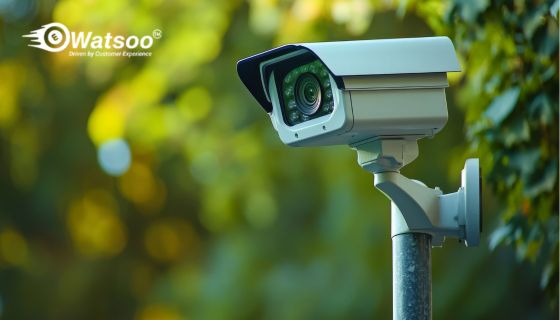
With the expansion and advancement of smart traffic and toll management across India, one common question that many new and existing users ask about ANPR and speed cameras:
Table of Contents
ToggleAre ANPR Cameras Speed Cameras?
At first glance, both look quite similar, are mounted on roads, capture vehicles in motion, and support law enforcement. Manufacturers design ANPR cameras for a different purpose than conventional speed-capturing cameras.
In this blog, we will dissect what ANPR actually does, how it works, and whether it is truly similar to speed cameras. Know about Watsoo, the best weighbridge automation solution provider in 2026.
What is an Automatic Number Plate Recognition System?
An Automatic Number Plate Recognition Camera system is a visual-recognition technology that captures vehicle number plates and translates them into digitally encoded data that machines can read.
A modern ANPR system typically includes:
- High-resolution IR cameras for day and night capture.
- Edge AI processors for fast recognition.
- Deep learning models that engineers train on Indian number plates.
- Backend software for alerts, analytics, and integration.
Modern ANPR systems go beyond traditional OCR by combining deep learning, edge AI, and contextual vehicle intelligence for higher accuracy and multi-lane performance.
Are ANPR Cameras the Same as Speed Cameras?
Our direct answer is: NO.
The speed cameras are chiefly designed to measure vehicle speed and issue penalties for overspeeding. Whereas, ANPR cameras primarily focus on:
- Reading Number Plates
- Identifying Vehicles
- Tracking Violations Beyond Speed
- Supporting Smart City and Toll Operations
Another important point is that authorities can use ANPR cameras for speed enforcement systems, which often creates confusion. Let us learn about ANPR cameras in detail here.
How ANPR Technology Has Evolved in 2026?
In 2026, ANPR is no longer just a number plate reader camera. It has become part of the intelligent traffic infrastructure.
Edge AI & Edge Computing
Most modern ANPR cameras process data directly at the edge. It reduces dependency on central servers. This is essential for toll plazas and high-speed corridors.
Deep Learning & CNN Accuracy
Advanced CNN models enable:
- Recognition of plates that dirt or wear has damaged.
- Support for multiple state formats.
- Accurate capture even over 120 km/h.
Cloud-Based ANPR Integration
Cloud connectivity allows:
- Centralised dashboards.
- Historical vehicle tracking.
- Cross-city data sharing.
Video Analytics Synergy
Modern systems combine ANPR with:
- Vehicle make and model recognition.
- Colour detection.
- Suspicious behaviour anomaly alerts.
Key Applications of ANPR in Telangana
Telangana is one of the leading states adopting ANPR as part of its smart mobility infrastructure. The adoption of ANPR for public infrastructure in Telangana has grown significantly.
ANPR for Toll Management in Telangana
With automated toll collection becoming the norm, ANPR plays a major role in:
- FASTag exception handling.
- Identifying non-compliant vehicles.
- Reducing toll leakage and fraud.
Highway authorities now deploy hybrid FASTag and ANPR models across expressways.
ANPR for Traffic Monitoring Telangana
Traffic police and municipal authorities use ANPR systems for:
- Red light violation detection.
- Speed enforcement support.
- Stolen vehicle identification.
- Real-time congestion analysis.
In a nutshell, ANPR is not a speed camera; however, it reinforces the enforcement when combined with the speed monitoring devices. Authorities enable speed enforcement when they integrate ANPR with radar-based or average-speed monitoring systems.
Frictionless Parking Management
ANPR enables ticketless parking by:
- Automating entry and exit.
- Linking number plates with payment systems.
- Eliminating physical tokens or RFID tags.
Smart City Infrastructure Integration
ANPR solution providers in Telangana are increasingly deploying systems that connect with:
- Integrated Command and Control Centres (ICCC).
- Emergency response systems.
- Urban mobility platforms.
Key Features to Look for in an ANPR System
While you are assessing an ANPR camera price in India, choosing a deployment partner, or simply want to know the range, make sure that the system provides:
- Multi-factor vehicle identification (MMR).
- High-speed multi-lane capture.
- Mobile ANPR units for enforcement vehicles.
- Data privacy compliance with Indian data protection frameworks.
- Global privacy standards, where applicable.
- API-based integration with government portals.
- Live immediate anomaly alerts.
You can trust Watsoo for a comprehensive ANPR system in 2026. Watsoo is among India’s leading ANPR solution providers with integrated modern technologies like automated Electronic Toll Collection (ETC) support, faster toll transaction analytics & fraud control, and a scalable platform for expanding demand.
Cost of Automatic Number Plate Recognition Systems in India
The cost depends on deployment size and application. Typical components include:
- Fixed or mobile ANPR cameras.
- Edge servers or processors.
- Software licensing.
- Integration and commissioning.
- Annual support and maintenance.
Indicative Pricing:
- Small deployments: INR 1.5 to INR 3 lakhs per lane.
- Large smart city projects: Custom enterprise pricing.
Indicative pricing may vary based on hardware, software, analytics, and deployment complexity. For businesses comparing ANPR Camera Price in India, solution design matters more than hardware alone.
RFID vs ANPR: Which is Better for Vehicle Identification?
The move towards smart mobility in 2026 is prompting infrastructure planners to decide between RFID and ANPR. According to the latest figures, here is a precise summary of these two technologies:
Hardware Requirements
- Users attach a physical tag (such as FASTag) to the vehicle’s windshield.
- ANPR is entirely “tagless” as it identifies vehicles only through a combination of high-resolution cameras and AI.
Enforcement Strength
- RFID is quite a limited technology because a tag is required only for a vehicle to be tracked; the system cannot identify a vehicle that is “off-grid” or a vehicle with a faulty tag.
- ANPR is a strong enforcement tool because it records visual evidence of each vehicle, making it easier to issue fines for speeding or red-light violations.
System Scalability
- RFID is of a medium scalability level since it needs a large logistics network to distribute and register physical tags for every user.
- ANPR is very scalable; the only thing you need to do is place more cameras to cover more lanes, and the system will instantly work for any vehicle on the road.
Recognition Accuracy
- RFID is very stable for data transmission.
- ANPR achieved “very high” accuracy in 2026 due to AI-driven Deep Learning, which can now decipher the plates even in heavy rain, dust, or high wind.
Primary Use Cases
- RFID has the greatest potential for revolutionising payment in difficult situations such as electronic tolling and gated community access.
- ANPR is the comprehensive solution that can be used for tolling, city-wide traffic monitoring, smart parking, and police surveillance.
Currently, very few new infrastructure projects opt for a single technology. Most of them deploy Hybrid Systems where the RFID device is the payment instrument, and the ANPR camera serves as the visual audit and security enforcement.
Advantages and Disadvantages of ANPR Systems
Like any other digital system, the ANPR also has its own advantages and disadvantages.
Advantages
- Non-intrusive Vehicle Identification
- Live Analytics and Alerts
- Scalable Across Highways and Cities
- Works Without Physical Tags
Disadvantages
- Higher Initial Investment than Basic CCTV
- Requires Strong Data Governance
- Performance Depends on Camera Placement and Quality
Conclusion – Are ANPR Cameras Speed Cameras?
An ANPR Camera is not a speed camera by design. It is a powerful vehicle identification and intelligence system that supports tolling, traffic enforcement, smart parking, and smart city governance. ANPR cameras are not speed cameras by default, but they can complement speed enforcement when integrated with dedicated speed detection technologies.
Monitoring vehicle speeds is just one example of how ANPR can be used; however, the real power of ANPR is in automated vehicle recognition and delivery of real-time analytics. As India is investing in modern transport infrastructure, ANPR will be a core technology to enable smart and safe roads.
FAQs
ANPR cameras can support speed enforcement when integrated with speed detection systems, but they do not measure speed independently. These cameras are used to record traffic violations, enforce speed limits, and are capable of operating under any weather conditions.
Speed cameras are typically mounted on poles near highways and junctions, often accompanied by signage. They are commonly located near traffic signals, highway stretches, and city entry or exit points. ANPRs are number plate cameras that are different from speed cameras.
The function of ANPR (Automatic Number Plate Recognition) and speed cameras is to increase road safety, aid law enforcement, and ensure that traffic regulations are followed. They are used for the automatic detection, recording, and monitoring of vehicle movements.
Most modern ANPR cameras have an accuracy level of over 90 per cent in their readings. They feature technologies such as high-resolution imaging sensors, Infrared (IR) illumination to allow 24/7 visibility, and the use of special lenses to get a clear image of license plates.
In 2026, prominent ANPR solution providers include Watsoo, EFKON India, Vehant Technologies (TrafficMon), and Prama Hikvision. These companies are recognised for delivering high-accuracy, AI-driven systems designed for traffic enforcement, monitoring, and surveillance applications.