

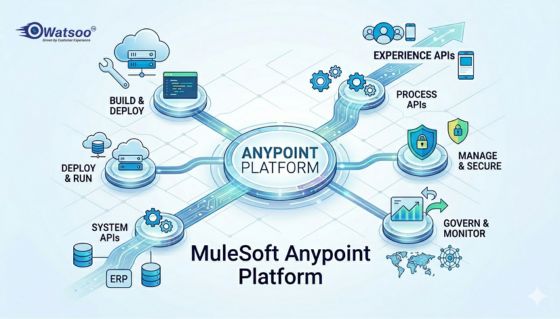
The MuleSoft Anypoint Platform has become the essential solution for modern enterprises that suffer from the inability of their various software systems to interact with each other. By moving away from manual data sharing between Salesforce and SAP, the MuleSoft Anypoint Platform eliminates errors and accelerates business growth.
Table of Contents
ToggleSalesforce accommodates client information. SAP handles finances. A custom mobile application serves customers. Consequently, when all these systems share data manually, which costs time, slows down business, and introduces errors.
To resolve this, the MuleSoft Anypoint Platform was built. This is a modern enterprise integration solution that connects systems, teams, and data through governed, reusable APIs. In 2026, it has evolved into the “Action Layer” for Enterprise AI, enabling autonomous agents to interact with legacy systems securely.
Still unclear? What is MuleSoft, and whether it fits your enterprise needs or not? This guide covers everything for you. MuleSoft integration platform basics, key MuleSoft Anypoint platform components, workable MuleSoft Anypoint platform architecture tutorial, MuleSoft API management capabilities, and much more. This guide will help enterprise architects, integration developers, and businesses looking forward to integrating the MuleSoft Anypoint platform choose between other tools.
What is the MuleSoft Anypoint Platform?
MuleSoft is an integration platform used to connect data, devices, applications, and APIs across hybrid, cloud, and on-premise environments. The MuleSoft integration platform enables developers to design reusable APIs that work as shared building blocks across the organisation. It stops the need to build custom one-off connections repeatedly.
This unified enterprise API platform manages the complete API lifespan from design to retirement. Salesforce acquired MuleSoft back in 2018, but the Anypoint platform continues to operate as a standalone enterprise integration solution. By the end of 2026, it will have become the backbone of the “Agentic” era, providing the secure data fabric required for Salesforce Agentforce and other AI frameworks to operate beyond Salesforce’s own ecosystem.
Its core benefits are faster integration & delivery, centralised MuleSoft API management, and reduced duplication through API reuse. It keeps consistent governance across teams and environments. Before going ahead with this guide, we should understand who can benefit from it.
Who Should Use It and Who Shouldn’t?
A MuleSoft Anypoint Platform implementation is appropriate for
- Companies handling multiple legacy systems, hybrid environments, and SaaS apps – in need of a governed integration layer.
- Enterprises deploying AI Agents that require real-time, governed access to back-office data.
- Companies that are replacing point-to-point integrations with reusable API-led connectivity.
- Governed industries that require monitoring, strict security, and Zero-Trust policy enforcement.
Who may it not be the appropriate alternative for?
- Small teams with few simple integrations.
- Companies prioritise the lowest upfront cost over long-term governance.
- Use cases that native connectors or a lightweight iPaaS can handle without a complete enterprise API platform.
You can connect with our experts for Watsoo MuleSoft integration services.
How the MuleSoft Anypoint Platform Works?
The MuleSoft Anypoint platform follows 6 steps for every integration. They are:
Design → Build → Deploy → Secure → Monitor → Reuse
The entire method together is API-led connectivity. This architectural philosophy turns integrations from disposable code into reusable enterprise assets. Furthermore, if one follows this API-led connectivity principle from day one, it prevents the architectural expense that ruins traditional programs over time.
The Three-Layer API-Led Connectivity Model
API-led connectivity organises every integration into three distinct layers, also known as the MuleSoft three-layer architecture.
- System APIs encompass core backend platforms – databases, SAP, Salesforce, Oracle, and mainframes. They display system capabilities in a controlled, stable way without revealing internal complexity.
- Process APIs work in the middle, combining and transforming data from multiple System APIs to fulfill specific business logic. This includes inventory checks, order validation, and client profile assembly.
- Experience APIs deliver data designed for a specific audience – be it a mobile app, a partner portal, or a Large Language Model (LLM) prompt. Distinctive channels get different APIs, all drawing from the same underlying layers.
Customer Onboarding: Real-life Example
- System API connects to the identity database and the CRM.
- Process API assembles the profile, validates it, and triggers provisioning.
- Experience API delivers the accurate data to the web form, mobile confirmation screen, and the AI support agent.
When the mobile app changes, the Experience API updates. The business logic underneath stays unbroken. This is the compounding value of API-led connectivity.
Anypoint Platform MuleSoft Components
Understanding the MuleSoft Anypoint Platform components is essential for any modern enterprise evaluation. In 2026, the ecosystem has shifted entirely toward containerization and cloud-native development.
Design Center: A web-based tool for API-first development. Teams define APIs in RAML or OAS and build mock endpoints to enforce standards before coding begins.
Anypoint Code Builder (ACB): The next-generation, VS Code-based IDE. It has largely replaced the legacy Anypoint Studio for designing, developing, and deploying integrations.
Runtime Manager (CloudHub 2.0): A fully managed, Kubernetes-based service. It utilizes “Replicas” for rapid scaling and simplified private networking, replacing legacy “Workers.”
API Manager: The central hub for MuleSoft API management. It enforces rate limiting, SLA tiers, and OIDC/JWT authentication across the entire API lifecycle.
Anypoint Flex Gateway: An ultra-lightweight gateway that manages and secures non-Mule services (Node.js, Python, etc.) from a single control plane.
Anypoint Exchange: A centralized marketplace for reusable assets. It allows teams to discover pre-built templates, APIs, and connectors to multiply development speed.
Anypoint Monitoring: Provides real-time telemetry and global tracing. In 2026, it includes specialized dashboards for tracking AI agent performance and token usage.
Anypoint MQ: A cloud-native messaging service for asynchronous architectures, ideal for retry logic and handling high-traffic bursts.
DataWeave: The high-performance transformation language of MuleSoft, capable of mapping complex data between JSON, XML, CSV, and EDI.
MuleSoft Connectors: Ready-made adapters for systems like SAP and Salesforce, significantly reducing custom integration build time.
MuleSoft Anypoint Platform Architecture Tutorial
Our MuleSoft Anypoint platform architecture tutorial focuses on patterns, decision points, and structure to guide teams practically, moving from evaluation to design.
Core Layers
A well-designed MuleSoft architecture maps cleanly to the API-led connectivity model.
- Customer Apps (Mobile, Web, Partners) call Experience APIs.
- Experience APIs call Process APIs for business logic.
- Process APIs call System APIs for backend data.
- Governance and security services run across all layers.
Loose coupling between these layers is an architectural benefit, as one can change a mobile Experience API without touching the SAP system API underneath it.
Deployment Models
These models decide where your MuleSoft Anypoint Platform APIs run and are managed. The MuleSoft Anypoint platform primarily supports three deployment formats.
- CloudHub 2.0 – A fully managed, Kubernetes-based iPaaS. Best for cloud-first organisations and high-availability needs.
- Runtime Fabric (RTF) – Allows you to run Mule applications on your own Kubernetes service (AKS, EKS, GKE).
- Hybrid – Mule runtimes on-prem or in private cloud with CloudHub management plane, best for regulated data environments.
Security Architecture
Strong security is built into the MuleSoft Anypoint platform features at every layer.
- OAuth 2.0, SAML, and client ID enforcement via API Manager.
- Edge-to-core security using Flex Gateway and automated policy application.
- Secrets management for credential storage and rotation.
- Centralized MuleSoft API management policies are applied consistently.
Reference Architecture: Customer 360
A practical end-to-end example that maps all MuleSoft Anypoint platform components together.
- System APIs wrap Salesforce (CRM), SAP (orders), and a data warehouse (analytics).
- Process APIs assemble a unified customer profile with order history and account status.
- Experience APIs deliver it to a service portal, mobile support app, and the customer service AI bot.
- API Managers enforces OAuth and rate limits on all inbound calls.
- Anypoint Monitoring tracks latency and errors in real time.
This pattern is reusable across banking, healthcare, retail, and telecommunications. This makes it the strongest starting point in any MuleSoft Anypoint platform architecture tutorial.
MuleSoft Anypoint Platform vs Traditional Integration
Ever compare MuleSoft and Traditional Integration processes? Most enterprise architects face this question. Let’s understand the traditional integration conflict first.
Traditional point-to-point integration creates direct dependencies among systems. When ten systems each connect to 5 others, you get fifty connections to maintain. When one system changes, the rest of everything is disturbed.
The MuleSoft integration platform replaces that dependency with structured API layers. These layers are governed, monitored, and reusable. In 2026, the difference is even more stark: traditional integration creates a data silo that AI cannot access, while MuleSoft creates a “Data Fabric” that powers automation.
Common MuleSoft Anypoint Platform Use Cases
As an enterprise integration solution, the MuleSoft integration platform manages a wide range of business-critical scenarios.
- Application Integration – Connects CRM, ERP, HR, finance, and support systems with managed, monitored APIs.
- Legacy Modernisation – Wrapping traditional systems with System APIs rather than replacing them. The MuleSoft integration platform expands the working life of old platforms while minimising direct dependencies progressively.
- B2B and Partner Integration – A structured partner onboarding secures data exchange and standardizes API access for orders, inventory, client data, and shipments.
- Omnichannel Experiences – The Experience APIs empower mobile apps, portals, and ecommerce platforms from shared backend logic. When business rules change, it updates the flow through the API layers rather than across every channel individually.
- AI and Data Integration – Providing the “Action Layer” for autonomous agents to execute business tasks across different platforms securely.
How to Plan a MuleSoft Implementation?
You can implement MuleSoft services following the given steps:
Start by Focusing on Business Results
- Determine which workflows are the most frustrating. The most successful initial MuleSoft project is not the most technically demanding integration on the plan, but rather one that produces an observable, quantifiable outcome.
Evaluate Restrictions and Systems
- The scope includes inventory systems, APIs, data formats, authentication techniques, latency requirements, and compliance restrictions. Check the availability of MuleSoft connectors for your priority systems, specifically looking for CloudHub 2.0 compatibility.
Construct the Operational Model
- Before the first line of code is created, specify who is responsible for runtime operations, security policies, API design guidelines, and Exchange governance. Even the most skilled MuleSoft Anypoint Platform installation specialists are unable to make up for organizational ambiguity in the absence of a clear operational model.
Collaborate with Anypoint Platform MuleSoft Integration Professionals
Experts in MuleSoft Anypoint Platform implementation speed up results in ways that internal teams unfamiliar with API-led connectivity seldom match on their own. In 2026, experts are essential for navigating the transition to Anypoint Code Builder and setting up Flex Gateway architectures.
Rollout Phases
Planning a MuleSoft implementation requires a phased strategy:
- Phase 1: Initial System API, CloudHub 2.0 configuration, and security baseline
- Phase 2: Initial Production Process and Experience APIs with Real-Time Monitoring.
- Phase 3: When Phase 1 assets are reused in a second use case, ROI becomes apparent.
- Phase 4: Team onboarding, governance norms, and exchange adoption goals.
Key Strategies for MuleSoft Success: Exemplary Approaches
Build Reusable MuleSoft Anypoint Platform Designs From the Start.
- Build Reusable Designs From the Start. Create APIs with unambiguous contracts, versioning rules, and exchange documentation. Avoid integrating channel-specific functionality in shared layers; this is the most prevalent error that degrades the value of API-led connection with time.
- API Manager Helps to Improve Security. Centralize shared policies for authentication, rate restriction, and access tracking. Make MuleSoft API management decisions consistent across environments rather than leaving them up to individual developers.
- Detect Before Users Complaint. Set baseline metrics, latency thresholds, and failure alarms before going live. Use Anypoint Monitoring’s new AI-anomaly detection to stay ahead of errors.
- Make Exchange Actually Useful. Provide samples, schemas, known limits, and owner information. Internal discoverability distinguishes Exchange as a dynamic asset catalog from an ignored corporate obligation.
Conclusion
The MuleSoft Anypoint platform is suitable for enterprises that need a governed, reusable, API-led integration strategy at scale. The API-led connectivity model separates it from conventional middleware & fragile point-to-point connections.
In 2026, you can hire MuleSoft integration developers to implement CloudHub 2.0 and Flex Gateway for a future-proof integration solution. These implementation experts make complex architectures smooth. Building your first API layer correctly is essential, as it becomes the foundation for everything else.
FAQs
The MuleSoft Anypoint platform is used to build, design, manage, deploy, and monitor integrations and APIs. It replaces point-to-point code with a well-structured, reusable API program across enterprises.
The core components are CloudHub 2.0 (Runtime Manager), API Manager, Design Center, Anypoint Code Builder, Anypoint Monitoring, Anypoint Exchange, Flex Gateway, Anypoint MQ, DataWeave, and MuleSoft Connectors.
API-led connectivity organises integrations into System APIs (Backend Access), Process APIs (Business Logic), and Experience APIs (Channel Delivery). Each layer can change independently without breaking the others.
The primary difference is that MuleSoft replaces fragile point-to-point connections with governed, reusable API layers. In 2026, MuleSoft will also provide the secure infrastructure needed for AI automation.
Hire experts for setting up CloudHub 2.0, designing complex architectures, migrating from traditional integration, or implementing Flex Gateway and AI-integrated workflows.